
“Let’s list a little higher. We can always come down.”
It’s an understandable thought. You want room to negotiate, and you don’t want to discover later that you could have asked for more.
I’m a Burlington-based Broker with RE/MAX Escarpment Realty Inc., Brokerage, and I’ve served more than 3,000 homeowners across Burlington, Oakville and surrounding communities.
A buyer has to choose your home before there’s anything to negotiate. An asking price that looks too high can stop them from booking a showing altogether.
That’s the risk I want Burlington sellers to understand. You can have a well-kept house and professional photographs, yet lose buyers’ attention by starting too high. The rejection happens before you get the chance to hear an offer.
TL;DR
- A high launch price can put your home outside buyers’ search limits, even when you’re willing to negotiate.
- Review your first week’s activity against comparable Burlington listings. A quiet week alone doesn’t prove overpricing.
- Base your asking price on what similar Burlington homes have actually sold for, accounting for differences in condition, layout and lot size.
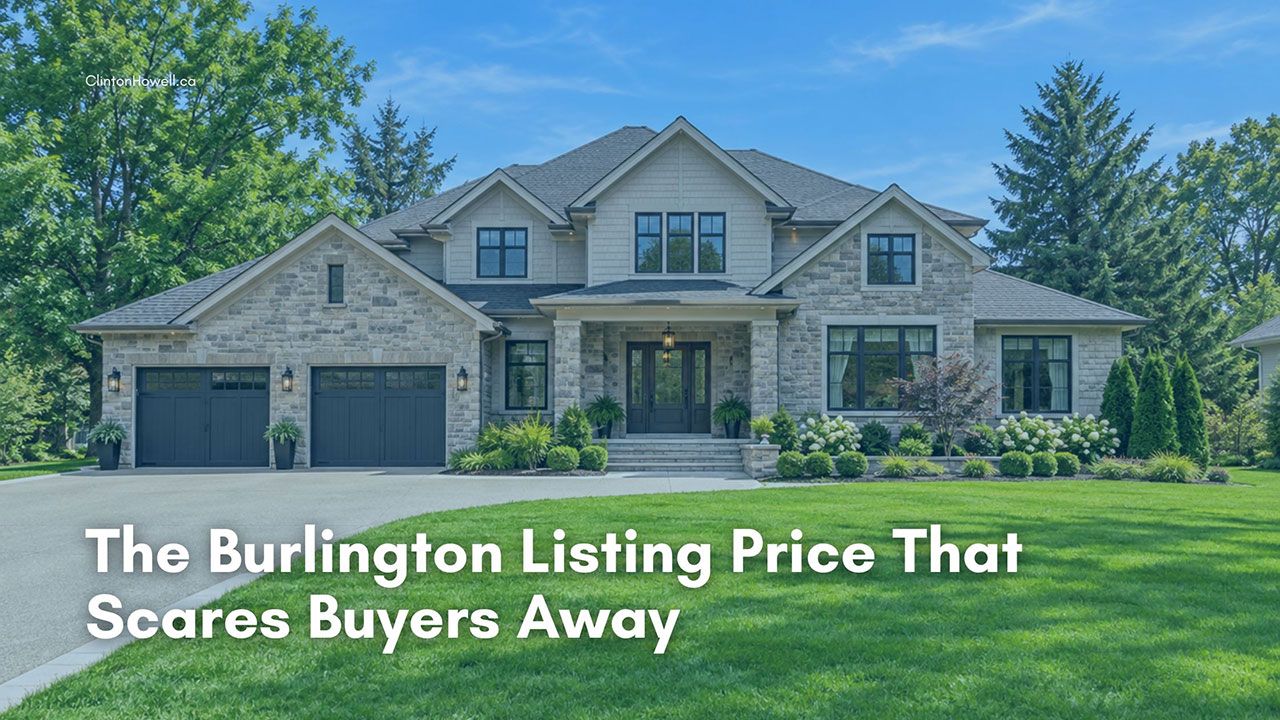
How an Extra $25,000 Can Hide Your Listing
Imagine listing your Burlington home at $1,225,000, with the expectation that you’ll negotiate somewhere around $1.2 million.
A buyer sets their maximum search price at $1,200,000. Your home falls outside those results, even though you might accept a price they could afford.
Your willingness to negotiate can’t help someone who never encounters the listing.
Meanwhile, buyers searching above $1.2 million may be comparing your home with properties that have another bedroom, a larger lot or more recent updates. You’ve put yourself beside a different set of alternatives. Does your home justify the comparison?
Before settling on an asking price, I want to look at the homes a buyer would see alongside yours. Which one would they book first?
Search thresholds deserve attention, but the number still needs support from comparable sales. Ending a price in “999” won’t rescue an unrealistic valuation.
What the First Week Can Tell You

My team sends buyers suitable new listings the day they come out. Some of those buyers have already toured several homes. They have a good sense of what their budget buys.
That makes their early response useful.
Did enquiries turn into appointments? Could people book a convenient showing? Did they visit once and move on, or ask for more information?
Our weekly seller updates cover activity and recurring feedback. I want us discussing those details while we can act on them, rather than waiting several weeks to ask why the house is still available.
Before you list, ask what response would trigger a price review and when you’ll discuss it. That makes a disappointing week easier to evaluate without rushing into a decision.
The first week is a review point. An Orchard townhouse and a custom Roseland home need different expectations because their buyer pools differ. Seven quiet days alone won’t tell us that either home is overpriced.
For perspective, Cornerstone’s full-year 2025 Burlington statistics show detached homes averaged 30.6 days on market, while apartments averaged 49.7 days. Those historical averages show how selling timelines differ by property type. Neither figure proves that an individual listing was overpriced.
The better question is how your listing is performing beside genuinely comparable properties.
The Sale Down the Street Needs a Closer Look
Your neighbour’s selling price is worth investigating. So are the details behind it.
Was the house renovated? Did it have a deeper lot, another bathroom or a more practical layout? When did it sell?
In Aldershot, older bungalows sit within a neighbourhood that also has newer infill and condos near the GO station. Those differences between Burlington homes and neighbourhoods matter. Sharing an area name doesn’t make two properties good comparables. Roseland’s mature lots and custom homes also call for different comparisons from the smaller lots common in The Orchard.
When reviewing a neighbour’s sale, ask for the original asking price as well as the final sale price. “They got close to asking” tells you little if they reduced the price twice first.
Recent sales show what buyers agreed to pay. Active listings show your competition. An unsold listing needs more investigation before we treat its asking price as evidence of value.
Then there’s what your home means to you, and how much you need for the next purchase. Both deserve a proper conversation. Buyers will still compare your house with their other choices.
If the supported selling range won’t fund your planned move, I’d rather work through that before you commit to buying another home.
How Much of Your Renovation Will Buyers Pay For?

You know exactly what the kitchen cost. You’ve kept the invoices, and you remember living through the work.
Those costs help explain what you spent. To support a higher asking price, I need to look at sales of homes with comparable improvements.
I’ve covered renovations that may not pay back before selling, including major landscaping work and basement remodels. A finished space can make a home more appealing without adding the full construction bill to its selling price.
Ask which recent sales support a premium for your renovation, and how much.
A buyer may appreciate your custom cabinetry but place more importance on having another bedroom. We need to consider the whole property when setting the price, rather than adding every invoice to what you originally paid.
Signs Your House Is Overpriced
One quiet weekend or a disappointing offer gives us limited information. I look for patterns, while checking the other reasons a Burlington home may struggle to sell.
Very little online attention. First, check that the listing is appearing where it should, with the correct details and a strong lead photograph. Then examine which price searches include it. A visibility problem needs attention before we assume buyers have rejected the price.
Views without showing requests. People are finding the listing, but something is stopping them from visiting. Compare its price and presentation with other available homes. Check for missing information and showing restrictions that make appointments difficult.
Showings without offers and repeated price objections. One visitor’s opinion carries less weight than several buyers making the same comparison. Ask what they preferred elsewhere and whether your price accounts for that difference.
Similar homes are selling while yours stays available. Look closely at what those buyers chose. If comparable properties keep selling for less, we need stronger evidence to justify holding your price.
These are the kinds of patterns we track through our listing service and seller updates. When an overpriced house isn’t selling, waiting becomes harder to defend once exposure, feedback and competing sales all point to the same problem.
If similar homes across your price range are also sitting, we need to account for that slower pace. Your home’s activity only makes sense when we compare it with the right properties.
Buyers Can Read Your Price Reductions
When we evaluate a property for a buyer, we provide nearby sold prices, time on market and the listing’s price-change history. Sellers should expect buyers to ask for that information about their home too.
Return to our hypothetical $1,225,000 listing. Reducing it to $1,210,000 still leaves it outside a search capped at $1.2 million. A reduction to $1,199,000 crosses that ceiling, although comparable sales must still support the price.
That’s why I would question a series of small reductions that never address the original problem.
Buyers following the listing may start wondering whether another reduction is coming. They may wait, or see an opportunity to make a lower offer. You could find yourself defending the history of the listing while trying to negotiate its current price.
A longer time on market doesn’t prove there’s anything wrong with the house. It does invite questions. A well-supported correction gives buyers a reason to reconsider, especially when we can explain how the new price compares with their alternatives.
Price for the Competition You Actually Have
Avoiding Burlington home pricing mistakes starts with a supportable value range. Then we consider where your asking price belongs within it, given the homes buyers can view this week.
In its July 2026 market report published by CREA, Cornerstone recorded 4.6 months of housing supply across Hamilton, Burlington, Haldimand and Niagara North. The association described inventory as high by the area’s historical standards, giving buyers more choice. For your listing, we need to narrow that regional picture to the homes your buyer would actually consider.
I also caution sellers about underpricing to attract competing offers. A low number and an offer date won’t create demand that isn’t there.
For an existing listing, correct problems with photography, missing information or showing access promptly. When adequate exposure, repeated feedback and relevant sales point to a price mismatch, choose an adjustment that addresses the gap.
Before offers arrive, work out which terms you can accept. Compare your likely net proceeds, the cost of continuing to own the home and the closing date you need. A supported offer deserves consideration even when it falls short of your original hope.
Holding your price can be reasonable when the evidence supports it. “We’ve already waited this long” gives us very little to work with.
Before You Set Your Burlington Asking Price
Before we put a price beside your home, let’s look at the properties buyers will compare it with. Bring your questions about the neighbour’s sale, your renovations and what you need from the move.
Already listed? Ask your listing agent to walk you through recent activity, buyer feedback and competing sales. You deserve a clear explanation of what supports keeping or changing the price.
Planning to sell in Burlington? Contact me to discuss your home’s asking price and the sales evidence behind it. We’ll work through the numbers before your listing goes live.